
The Journey of Kuchipudi: From Yakshaganam to the Solo
Sreelakshmy Govardhanan
Marina Harss
October 15, 2026 at 7:00 PM
Danspace Project
131 E 10th St.
New York, NY 10003
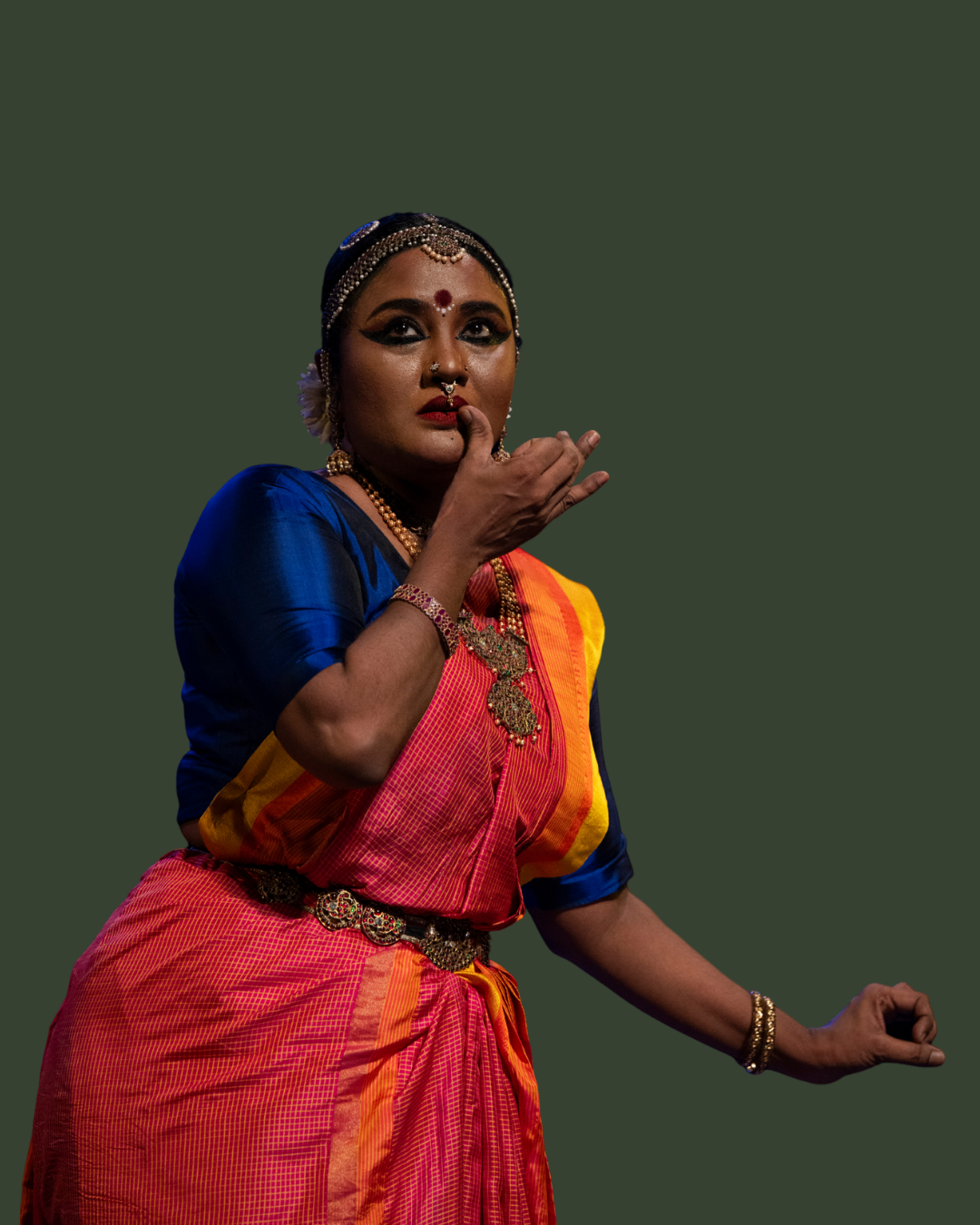
To watch Sreelakshmy Govardhanan perform is to witness a body surrender to, and simultaneously command, the extraordinary demands of Kuchipudi. “Surrender, unlearning and absorption” is how Govardhanan describes the development of her practice: a state in which rigorous technique unfurls into something far more elusive and expansive. For The Journey of Kuchipudi, Govardhanan will present a solo performance interspersed with historical and cultural context, followed by a conversation with dance critic and writer Marina Harss and the audience.
Yakshagana is a broad rubric for traditional dance theater and other embodied narrative forms that evolved in South India; Kuchipudi is an elaborate Yakshagana practice developed by South Indian Telugu-speaking communities. Centuries ago, Kuchipudi Yakshagana productions were full-scale community affairs characterized by lavish sets and live music. Its narratives were based on Indian epics and were performed exclusively by men, with female impersonators (stree vesham) playing women’s roles. With roots in the Bhagavathamelam, groups of itinerant performer-devotees who performed dance-plays based on Hindu scripture, from the 17th century Kuchipudi was practiced by the Telugu Brahmin families of Kuchipudi village, in Andhra Pradesh.
In the 1950s, Kuchipudi became embroiled in the cultural politics of a newly independent India, at the center of a classificatory debate about “folk” versus “classical” dance forms. Teachers began stripping the form of its large-scale theatrical ensemble context and teaching broken-down elements of Kuchipudi dramas as solos to eager students, who were no longer from their own families. This new category of students included not just women, but also people from other castes, locales, languages, religions and dance backgrounds. Between the 1950s and 1970s, a complex new national ecosystem of Kuchipudi emerged. Since the 1980s, Kuchipudi (among other “classical” dance forms of India) has been embedded in the cultural practices of a growing South Asian diaspora, as well as a globalized dance performance discourse—at once contemporary and deeply rooted in a linguistic and cultural context.
Today’s Kuchipudi is known predominantly as a solo dance form, and is often performed by women. In it, the individual becomes a subtle vehicle for the layered complexity of the ensemble. A solo Kuchipudi performer slips between many roles, mastering quicksilver changes of expression and body language. Playing both Rama and Sita in the moment their eyes first meet, a Kuchipudi performer almost gives the sense, in Govardhanan’s words, “of having split.” Such power is achieved through nuance: subtle expressions that invoke rather than represent, in masterful twitches of the eyebrow, calibrated eye movements, and small shivers of the cheek, lips, and chin. A Kuchipudi dancer’s lilting upper body and precise weight shifts are contrasted by propulsive, athletic footwork. Her formidable isolation and control, however, is never detached: a Kuchipudi performer is transported by the emotions of the performance, felt forcefully in her body, to an extent that approaches trance.
Born and raised in Kerala, Sreelaksmy Govardhanan encountered Kuchipudi as a teenager and became a disciple of the distinguished guru Pasumarthi Rattaiah Sarma at twenty-eight. To immerse herself more fully in the form, she learned Telugu in order to speak with her guru in the language of his tradition and to connect more deeply with the cultural world from which it emerged. Govardhanan is now widely recognized for her virtuosic footwork, extraordinary expressive range, and profound engagement with Kuchipudi’s transmission and evolution. Her abhinaya is particularly celebrated: an ability to make the smallest gesture carry astonishing emotional and narrative weight.
Marina Harss is a writer, journalist, and critic based in New York City, writing on all aspects of dance and occasionally on opera. Her features, profiles, reviews and interviews have appeared in: The New York Times, The New Yorker, The Nation, and The Guardian, among others. Her book on the choreographer Alexei Ratmansky, The Boy from Kyiv: Alexei Ratmansky’s Life in Ballet, was published by Farrar Straus and Giroux in October 2023.

RELATED
No related content found.